In depthEverything about opal
What opal is and what makes it flash, Ethiopian and Australian opal, opal and water, the story of the “unlucky” opal, what it has traditionally been used for, and how to look after it. Written by the team at our crystal shops in Derby and Leicester.
MineralOpal (silica with water)
The flashPlay of colour
Hardness5.5 to 6.5 out of 10
Found inEthiopia, Australia, Mexico
BirthstoneOctober
ChakraCrown · Heart
WaterKeep it dry (Ethiopian opal)
HeatKeep it cool
What opal is
Opal is silica, the same stuff as quartz, but it never formed crystals. Instead it is made of billions of tiny silica spheres stacked together with water trapped between them, usually 3 to 10% water by weight.
In precious opal the spheres are all the same size and line up in neat rows. Light bends as it passes between them and splits into colours, which flash and change as you turn the stone. This is called play of colour, and no two opals show the same pattern.
Ethiopian and Australian opal
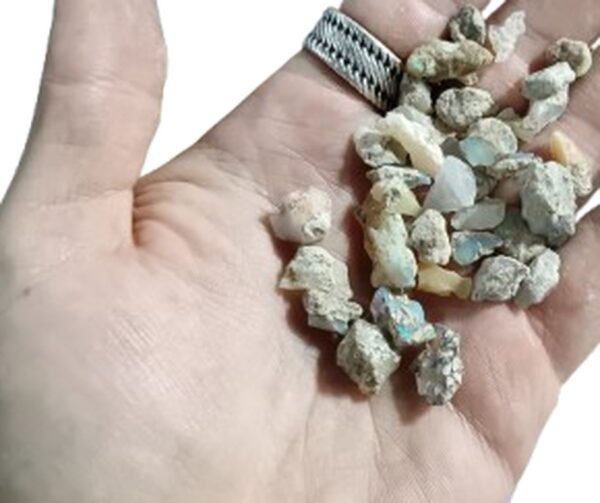
- Ethiopian opal: found in large amounts in the Wollo area of Ethiopia from 2008, in volcanic rock. Usually white to clear with bright, bold flashes, at a far gentler price. Ours is rough Ethiopian opal, just as it came from the ground.
- Australian opal: for over a century the source of most of the world’s precious opal, from the outback towns of Coober Pedy and Lightning Ridge, home of black opal.
- Mexican fire opal: a see-through orange to red opal, sometimes with no play of colour at all.
- Common opal: opal without play of colour, like pink opal.
Opal and water
Most Ethiopian opal is hydrophane: it soaks up water like a sponge. Wet it, and it can turn clear and lose its flashes for a while, then come back as it dries out slowly. Soaking it again and again, or drying it fast with heat, can cause fine cracks called crazing.
So keep Ethiopian opal dry: no rinsing, no water cleansing and no wearing it in the bath or shower. If it does get wet, let it dry slowly at room temperature for a few days.
The “unlucky” opal
Opal was once one of the most prized stones of all: the Romans valued it above almost everything. Its bad luck reputation is surprisingly recent. In 1829 Sir Walter Scott published Anne of Geierstein, in which a character’s opal hairpin seems linked with her fate, and opal sales in Europe slumped.
Queen Victoria helped to bring it back. She loved Australian opals and gave them to her family as gifts, and opal has been October’s birthstone ever since birthstone lists began.
What opal is traditionally used for
In crystal tradition, opal is a stone of creativity, joy and self-expression, said to reflect your feelings back to you like its changing colours. It is linked with the crown and heart chakras.
- Creativity: kept close for new ideas and inspiration.
- Joy: a cheerful stone for a lighter mood.
- Love: a traditional stone of romance and loyalty; see crystals for love.
- Birthdays: a classic gift for an October birthday; see our gift finder.
Opal and star signs
Opal is traditionally linked with Libra and Scorpio, whose birthdays fall in October, and also with Cancer and Pisces.
Be careful not to confuse it with opalite, a man-made glass with a milky blue glow, and with moonstone, whose sheen comes from a very different mineral.
Looking after opal
- Water: keep Ethiopian opal dry. Wipe it with a soft, dry cloth.
- Heat: away from radiators, hot windowsills and spotlights; sudden heat can crack opal.
- Knocks: softer than quartz, so store it on its own in a soft pouch.
- Cleansing: moonlight, a selenite plate or sound, never water. See which crystals can’t go in water.
More questions
What gives opal its colours?
Tiny silica spheres stacked in neat rows split light into colours as it passes between them. This is called play of colour.
Can opal go in water?
Keep Ethiopian opal dry. It soaks up water, can turn clear for a while, and repeated soaking can crack it.
What is the difference between Ethiopian and Australian opal?
Ethiopian opal is usually white to clear with bright flashes and soaks up water. Australian opal is more stable and includes rare black opal.
Is opal unlucky?
No. The idea comes from an 1829 novel by Sir Walter Scott. Before that opal was considered one of the luckiest stones.
Is opalite the same as opal?
No. Opalite is a man-made glass. Opal is a natural stone.
What is opal good for?
Traditionally creativity, joy, self-expression and love. Crystal meanings describe tradition and belief, not medical advice.
Crystal meanings describe tradition and belief, not medical advice.